

How I Designed My Home to Calm My Nervous System
Why some spaces help us relax—and others quietly stress us out.

One of my favorite feelings in the world is walking in my front door after a trip.
No matter how good the vacation, how beautiful the hotel, or how perfect the weather—when I step inside my home, it feels like a deep exhale. There’s the familiar scent (we’re always burning this candle, so that salty air and citrus have become the smell of home)/ I open up the sheer curtains in our living room to let in the light, and kick off my shoes to feel the soft rug under my feet. My shoulders drop, and I pull on the cozy sweats that tell my brain it’s time to relax.
I used to think this feeling was just about familiarity, but over the years, I’ve realized it’s so much more than that. The way my home feels isn’t an accident—it’s the result of hundreds of small, intentional design choices I’ve made with one goal in mind: to create a space that doesn’t just look beautiful, but actually calms my nervous system.
Most of us think about home design in aesthetic terms only. Does this couch look good? Do these throw pillows match? Is it on trend? But I’ve come to think of design as a way of speaking to all the senses and signaling to my nervous system how I want to feel.
Every room in your house makes you feel something. The visual noise, the lighting, the sounds, the scents, the textures—they’re all sending signals to your brain and body. And when you start paying attention to those signals and deciding how you want your home to feel, you can start designing in a way that doesn’t just look good on Pinterest, but genuinely supports your well-being.
The Five Senses Framework
I like to break it down into five categories: what you see, what you hear, what you smell, what you touch, and what you experience (that last one is about bringing nature into your home, more on that below). When I’m making a design decision for our home (and lately, for our Malibu renovation), I’m thinking about how the entire space will speak to the senses.
A recent example. A few months ago, I was standing in our bedroom and couldn’t quite put my finger on why it felt cluttered to my eye. The room was pretty minimal—neutral palette, linen bedding, a soothing painting above the bed. I finally realized: the console under the TV had open shelving that required way too much “stuff” to make it look full. I was constantly rearranging the book stacks, objects I’d picked up on trips, a tangle of cords peeking out. It was visual noise, and it was quietly stressing me out.
So, I swapped it out for this much simpler console with closed cabinetry. Now I can intentionally choose a few items to display on top—some books, a large vase with branches, a candle—and let the rest of the space breathe. The room immediately felt calmer (ie, I felt calmer).
Designing for the nervous system isn’t about following rules or trends, and you don’t have to be a minimalist. Maybe you want a room to energize you or fill you with joy! But it is about paying attention to how a space makes you feel, and then making small, intentional shifts that support how you want to show up each day.
Visual Calm: What Your Eyes Take In
This one often sneaks up on people because of outdated design “rules” we think we have to follow. Rules such as:
Every wall must have art on display.
Every room needs a pop of color.
Every surface needs a decorative item.
I used to buy into those, too—but somewhere along the way I realized that those rules didn’t always apply to the spaces I loved most. Some of my favorite rooms embrace unexpected negative space and are in monochromatic color palettes.
We often don’t realize that what we’re visually taking in is stressing us out, but our brains are constantly processing visual information. Too much of it (too many objects, too many patterns, too much stuff competing for attention) and your nervous system stays in a low-level state of activation.
In our home, I’m admittedly pretty ruthless about visual noise. Our main living space has an open floor plan with doors that open up to the patio, blurring the lines between inside and out. We made those choices intentionally when we built the house 14 years ago because I knew I wanted that sense of spaciousness and flow. But the magic is also in the smaller, more accessible decisions.
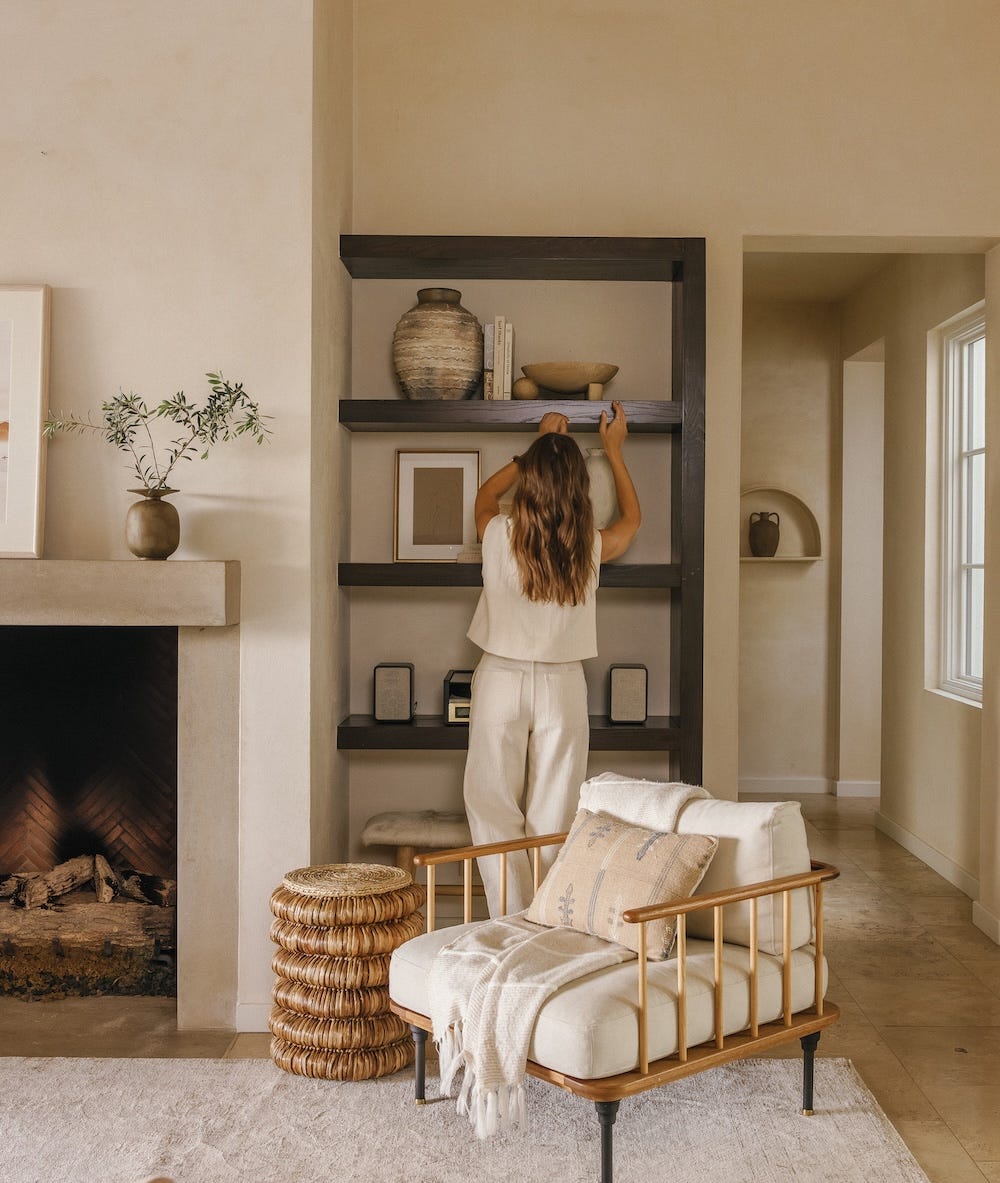
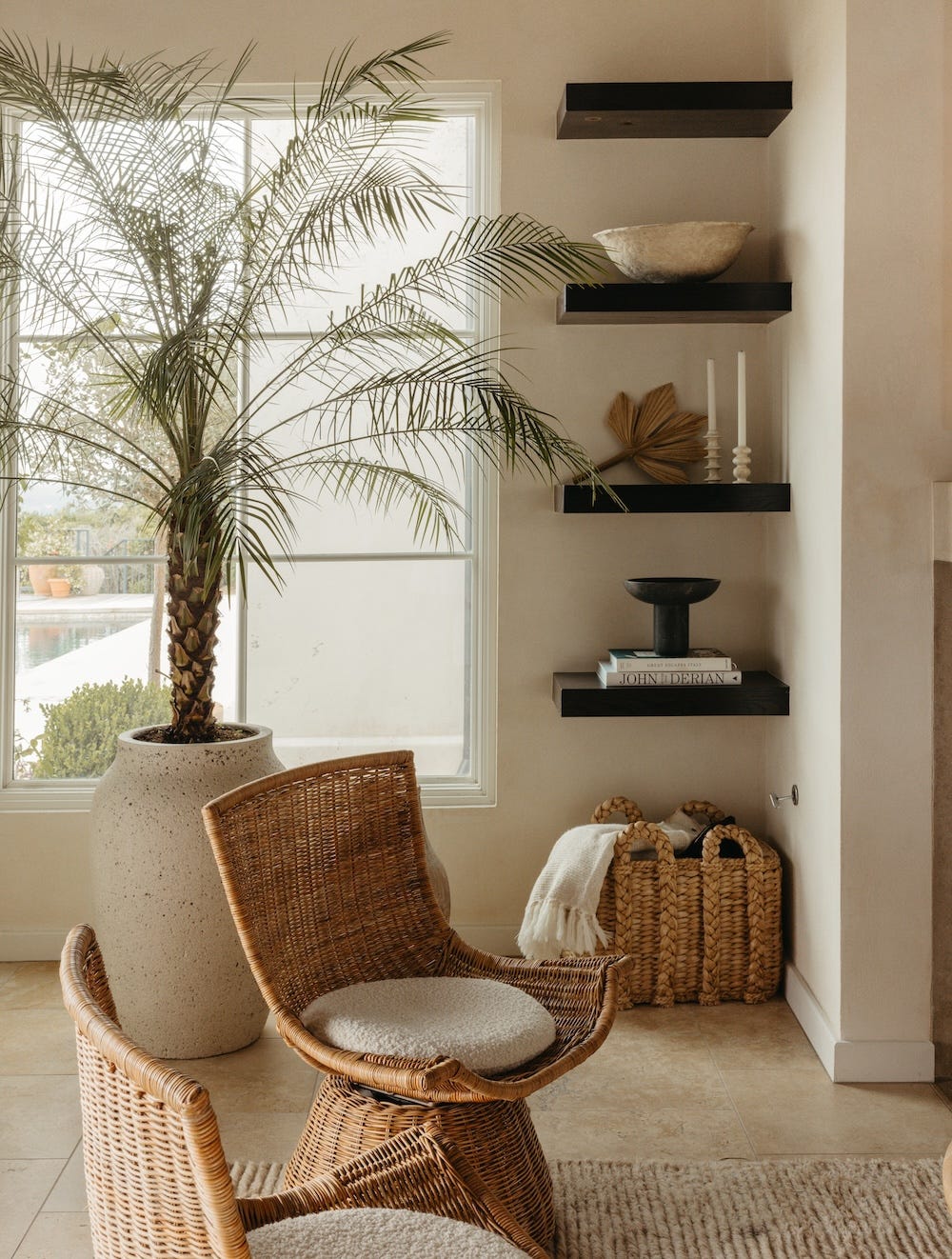
Rather than lots of framed art on the walls, I have one oversized photograph above our fireplace—a scene I captured in Italy of the Mediterranean sea and rocky cliffs. It brings nature in, while also making enough of a statement so that we don’t need other art in the room. I resist the urge to fill our open shelves with tchotchkes. Instead, I leave breathing room—a few books, some sculptural pieces, our record player for nights we’re feeling analog. It’s about choosing fewer items with more intention.
The same goes for our bedroom. I mentioned the console swap, but there are other choices too: our furniture is intentionally low-profile, which gives the room a more grounded, loungier feel. I keep nightstands clear with just a plant, a small tray for jewelry, maybe a book I’m reading. When I walk into the bedroom at the end of the day, there’s nothing my eyes have to “work” to process. It just feels calm.


Favorite Pieces for Visual Calm:
Console With Closed Storage: Game changer for hiding cords, remotes, all the random stuff
Oversized Wall Art: One large piece vs. a gallery wall creates visual calm
Sculptural Object: Something beautiful to anchor a shelf without clutter
Simple Tray: Corrals small items so they don’t scatter across surfaces
